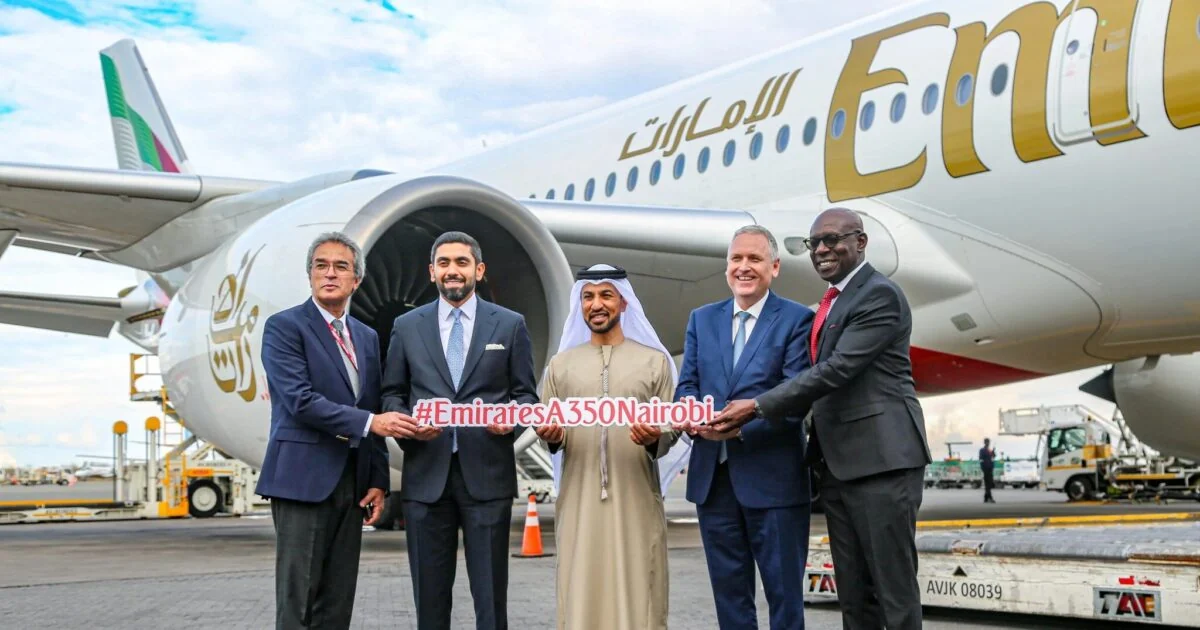
Dubai-based airline Emirates has introduced its Airbus A350 aircraft on the Nairobi-Dubai route, bringing its Premium Economy cabin to the Kenyan market as it expands its services to meet growing passenger demand. The aircraft has been deployed on the morning EK717 and EK718 flights, replacing a Boeing 777 on the two services. The airline will continue operating two other daily flights on the route using Boeing 777 aircraft. The introduction of the A350 gives passengers travelling from Nairobi access to Emirates’ Premium Economy product, particularly those connecting through Dubai to long-haul destinations in Europe and the United States. Rashid Al Ardha, Emirates Vice President for Commercial Operations in Sub-Saharan Africa, said Kenya remained one of the airline’s priority markets in the region. He said the introduction of an additional daily flight was aimed at accommodating growing passenger numbers and improving connections through Dubai. “Kenya has always been a very important market for us in East Africa, and as a gateway for a lot of the tourism that comes into Kenya and out of Kenya,” he said. “The third flight comes at a time when we have multiple connections coming in from the US and Europe, providing seamless connections for our travelers through Dubai.” Emirates introduced its third daily frequency to Nairobi on July 1, increasing its operations on the route to three flights daily. Al Ardha said Kenya was now the airline’s second-largest African market by capacity after South Africa. He added that Emirates would continue assessing opportunities to expand its regional network based on passenger demand. The Airbus A350 features Business, Premium Economy and Economy cabins, offering passengers more options depending on their travel preferences and budgets. Christophe Leloup, Emirates Country Manager for Kenya, said demand for Premium Economy had been growing, particularly among passengers travelling beyond Dubai to destinations in Europe and the United States. “We have been seeing the demand increasing for Premium Economy beyond Dubai, on the long-haul routes, especially for the US and Europe,” he said. Leloup said the airline had already been selling Premium Economy tickets to passengers connecting from Nairobi, even when the first leg of their journey was operated in Economy Class. “We were already selling a lot of Premium Economy, even though the first leg was in Economy Class, but customers were demanding that product,” he said. He explained that Premium Economy fares were generally priced around halfway between Economy and Business Class. However, the airline had not introduced a separate fare adjustment for the Nairobi market following the deployment of the A350. The introduction of the aircraft comes as Emirates implements a USD5 billion (approximately Sh650 billion) fleet refurbishment programme targeting more than 200 Boeing 777 and Airbus A380 aircraft. Al Ardha said the airline expected to have refurbished about 115 aircraft by the end of 2026, although the programme had experienced supply-chain delays. He also noted that deliveries under the Boeing 777X programme had been delayed, while new Airbus A350 aircraft continued arriving monthly. Despite expanding its services and upgrading its passenger offering, Emirates acknowledged that elevated global fuel prices continued to put pressure on operating costs across the aviation industry. Al Ardha said the airline was relying on fuel hedging and other cost-management strategies to manage the impact while maintaining competitive fares. He added that the A350 had fewer seats than the Boeing 777 but offered better fuel efficiency and lower unit costs. The airline said aircraft deployment and operating economics remained important considerations as it expanded its network and responded to changing passenger demand. The post Emirates Introduces Airbus A350 on Nairobi-Dubai Route appeared first on Kahawatungu .